science animation games
The Knowledge Makers

Go to item :

.Home | Products | Subscribe | Catalog | Register | Site Map | My Account | About Us |
Contact Us | FAQ | Announcement | Articles | Downloads | Discounts | Advertise | Feedback
MathematicsPhysics -  Heat, Light, atomic, General Chemistry - Physical,Analytical, Organic, Inorganic ChemistryBiology - Botany, Zoology, Microbiology,ImmunologyHuman Body system : Circulatory, Peripheral,Nervous,Mascular, sexual
>>
Make your purchases through verisign authenticated  payment gateway - ccavenue
   Science >> Physics >> Light >> Application
Login or Register   How do Optical Fibres work (Science and technology animation)  


You have products in your cart.


   New User Register


   Login Member:
Email:
Password:

   Site Search
   Advance Search
 
Other animations
Light - Pin hole camera (Animated physics for schools)
 

    education animation in flash online subscribe and view education animation online Subscribe and view online
Science and tech animation catalog in flash Animation product List
    education animation online in flash Row view of animated science  Row format
    physics, chemistry, biology animation Grid format of education animation  Grid format
    education animation  online catalog of animated education  Flash Format
    educational animation link  List format of educational animation  List format
    education animation link excel sheet of all educational animation in flash  Excel format

View full version -shop / subscribe

» Price list
» Check price in your currency 
» Advantage Shopping
» Advantage Subscription
» Compare shopping & subscription
» Shopping Process
» Payment options
» More details....

» License for school and others


New Discount Section
   Click to access discounts

Free Science Animation
   (Download Product Details) 720 kb

Advertise on Goalfinder
    Now you can advertise on Goalfinder to reach schools, colleges, teachers, parents, students and professionals.

Subscription opens up the site for you, view full length science animation and that too the latest versions, ready access to quizzes, ratings, games etc. Register and login to purchase subscription


Overview         (For age - group : Above 14 )


How can light travel for a large distance through cables made of glass and moreover carry information and data with it, total internal reflection comes to our aid here. This animated physics topic gives in-depth information about Optical Fibers and is very useful for teachers, students and industry.

Snapshots          Animated Preview - Watch a free preview of this science  and technology animation
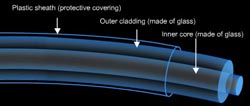
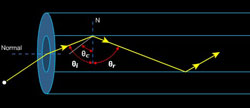
Construction of a fiber optics cable Physics of a light ray inside optical fiber
Construction of a fiber optics cable
Physics of a light ray inside optical fiber
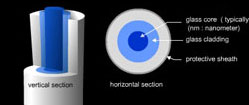
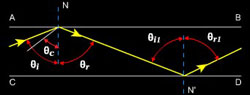
Glass core and the sheath of a cable Total internal reflection inside the cable
Glass core and the sheath of a cable
Total internal reflection inside the cable
Details of the animation/ movie /software

A principle called total internal reflection allows optical fibers to retain the light they carry. When light passes from a dense substance into a less dense substance, there is an angle, called the critical angle, beyond which 100 percent of the light is reflected from the surface between substances.

Total internal reflection occurs when light strikes the boundary between substances at an angle greater than the critical angle

Fiber optics makes use of certain special conditions, under which all of the light encountering the surface between two materials is reflected, to reduce loss.

Light can travel for long distances through fiber optic cables . In a process known as total internal reflection , light travels through a fiber optic cable by reflecting off the cable’s inner walls , even when the cable is bent. Although a fiber optic cable is transparent , almost no light escapes from it. Most fiber cables are ,made by pulling pure glass into long , fine strands.

Advantages of fiber optic cables over normal wires: Fiber optics can carry much more information in a much smaller cable.
1.No interference from electromagnet fields result in "clearer" connections.
2.No electrical resistance.
3.No hazard of electrocution if cable breaks.

Uses of Optical fibers:

Endoscopes uses optical fibers, which is used to view the internal organs

Information can be carried in the form of optical signal

Some decorative lamps and water fountains uses optical fibers

If you are still unclear about the concepts, please refer the animation below.

The animation also consists of

  • Sectional view of fiber optic cable
  • Detailed ray diagram about the propagation of light inside optical fibers
  • Detailed explanation of Total internal reflection taking place inside the cable
  • Analysis of ray path if the cable is bent sharply
  • Application of optical fibers
  • Data communication using the cable
Purchase to download and view unlimited times full-length animation or subscribe and view online all animation. More...

Product - Animation          Watch a free preview of this science  and technology animation
Description Preview Full Version Shop
Size (KB) 99 311 US$    14.00
Time (hr:min:sec) 0:1:0
Preview
0:9:0
Add To Cart
                                                                     Check price in your currency
Pay only $2 to watch full length animation online

Optical Fibers :

Category : Science

Type : Animation
Duration
: 9 minutes

The animation also consists of

  • Sectional view of fiber optic cable
  • Detailed ray diagram about the propagation of light inside optical fibers
  • Detailed explanation of Total internal reflection taking place inside the cable
  • Analysis of ray path if the cable is bent sharply
  • Application of optical fibers
  • Data communication using the cable

Official PayPal Seal
Prices are for single user license, refer for School license here, You can also Subscribe to view full animation, More .. Note: (Some full version software does not contain sound),
Related Products
 
Buyers Feedback:

Q & A
Q1: how do optic fibres work nathan 30/6/2010
Ans:
Q2: what are the losses of laser optical fibre? vasu yadav 27/12/2008
Ans:
Q3: how does laser optical fibre carry in formation? vasu yadav 27/12/2008
Ans:
Q4: what is laser optical fibre? vasu yadav 27/12/2008
Ans:
Q5: what is the principle of laser optical fibre? vasu yadav 27/12/2008
Ans:
Q6: how does laser optical fibre work? vasu yadav 27/12/2008
Ans:
Q7: how does optical fibres carry information? harley 21/10/2008
Ans:
Q8: what are the uses of optical fibres? tOyA_o8 1/9/2008
Ans:
Q9: what is an optical fibre? casper 28/7/2008
Ans: Optical fiber (or fibre) is a glass or plastic fiber that carries light along its length. Optical fiber carries much more information than conventional copper wire and is in general not subject to electromagnetic interference and the need to retransmit signals. Most telephone company long-distance lines are now of optical fiber.
Q10: how is optical fibre useful in communication technology? casper 28/7/2008
Ans: Fiber optic cables have a much greater bandwidth so they can carry more data. Fiber optic cables are less susceptible than metal cables to interference. Fiber optic cables are much thinner and lighter than metal wires. Data can be transmitted digitally (the natural form for computer data) rather than analogically. The information can be transmitted over longer distance as light undergoes lesser attenuation as compared to electrical cables. Wiretapping is more difficult as compared to electrical cable,
Q11: thx so much for this website... i LUV all ur animations they're reli helpful and all the questions helped me heaps... i luv this site and again thank you casper 28/7/2008
Ans: Thanks
Q12: Exactly how does 'Total Internal Reflection' work in firber optics? Andrew 14/5/2008
Ans: Optical fibers are based entirely on this principle of total internal reflection. An optical fiber is a flexible strand of glass. The light enters the glass cable, the light will hit the wall at an angle higher than the critical angle and will all be reflected back into the fiber. Light passes through a material with a high index of refraction, typically glass or plastic. This material is surrounded by material with a lower index of refraction. If the light strikes the sides at a large enough angle, it totally reflects and stays inside.
Q13: explain intramodel dispersion with example? jaspal 25/3/2008
Ans: Intramodal, or chromatic dispersion occurs in all types of fibers. Due to the fact that different wavelengths travel at different speeds, even within the same mode. It is of two types material and waveguide. Material dispersion occurs because the spreading of a light pulse is dependent on the wavelengths' interaction with the refractive index of the fiber core. Different wavelengths travel at different speeds in the fiber material and exit the fiber at different times. It is a function of the source spectral width. It is less at longer wavelengths. Waveguide dispersion occurs because the mode propagation constant is a function of the size of the fiber's core relative to the wavelength of operation, it also occurs because light propagates differently in the core than in the cladding.
Q14: explain losses of fibre optics? jaspal 14/3/2008
Ans: Losses are through connectors (0.75 db) , splices ( 0.75 dB) and attenuation per kilometer (0.35 dB). End gaps cause two problems, insertion loss and return loss. The emerging cone of light from the connector will spill over the core of the receiving fiber and be lost. In addition, the air gap between the fibers causes a reflection when the light encounters the change n refractive index from the glass fiber to the air in the gap. This reflection (called fresnel reflection) amounts to about 5% in typical flat polished connectors, and means that no connector with an air gap can have less than 0.3 dB loss.
Q15: what is meant by cladding Haresh 1/4/2007
Ans: Light passes through the glass or plastic core fiber using total internal reflection, the fiber core is surrounded by a thick cladding layer of lower refractive index than the core and whose main purpose is to restrict the signal to the core either at its boundary with core or in a grdual manner as in graded –index optical fibers.
Q16: What is the atomic model of an optical fiber? Sarah 30/3/2007
Ans: It is the quantum model but one where stimulation takes precedence over spontaneous emission of photon by excited electrons. Stimulation means that an incoming radiation can stimulate a laser electron to emit a photon in the same direction leading to amplification of the incoming wave.
Q17: how does total internal reflection apply in endoscopes? SONU 23/3/2007
Ans: Endoscopes use a fiber optic cable to transmit light and images through curved structures. This is based on the phenomenon of total internal reflection, light undergoes multiple reflections inside the cable but does not escape through the body of fiber optic cable , this makes it extremely useful for data transfer and imaging.
Q18: how optical fibre helps in diagonosis younus 23/3/2006
Ans: Fiber-optic probe is used for non-contact diagnosis of interior parts of eyes. For illuminating remote regions of the body, and carry understandable images back out to the doctor. They are used for Metabolic imaging of tissues by infrared fiber-optic spectroscopy, they direct radiation onto tissue, collect those radiation subsequently emitted by the tissue and deliver them for spectral analysis. They also detect substances like disease-indicating proteins in blood, useful in diagnosis.
Q19: explain how i develop flash animations on dwdm rajesh 10/3/2006
Ans: Welcome back Rajesh, could you be more specific as to where you are facing a problem in animating it, we had tried to address this issue some time back ( pls. refer answers below). If could be more clear than we will be more useful to you.


Comments or Questions
  Give your feedback or ask a question.
Name *
Email *
Question *
Enter Code
Code Image - Please contact webmaster if you have problems seeing this image code Load New Code


Home | Products | Subscribe | Catalog | Register | Site Map | My Account | About Us | Contact Us | FAQ | Articles | Announcements | Downloads | Discounts | Advertise | Feedback
Copyright ©2007 Goalfinder.com All rights reserved. Copyright | License | Privacy policy | Contact us |