|
You have products
in your cart.
New User Register

Login Member:
|
| |
| Advertise on Goalfinder |
| |
Now you can advertise on Goalfinder to
reach schools, colleges, teachers, parents,
students and professionals. |

|
|
|
How and why are mirages formed in desert, This educational science animation explains this phenomenon on the basis of heating of air and total internal reflection of light. Useful for understanding optical densities, critical angle and refraction.
|
|
|
|
|
We perceive
a reflection where there is none
|
The mirage occurs
due to total internal reflection
|
|
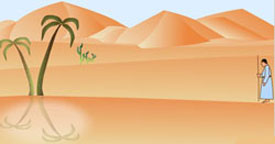
In desert, one may see images
of distant trees during high temperature . Since in nature,
images of trees are formed only in water, therefore one
is tricked into believing that a tree is situated near some
water body and its reflection is being seen.
However, on reaching spot , it is found that the water
has vanished . This phenomenon is called mirage.
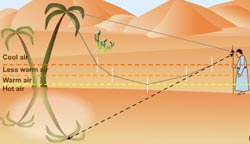
Mirage occurs due to total internal reflection of light.
When the sun is high in the sky, the sand gets heated first
and then the layers of air above it. The rays from the trees
travel from an optically denser air layer to a rarer layer
and hence bend away from the normal. This bending continues
and a stage is reached where the angle of incidence becomes
greater than the critical angle and total internal reflection
takes place.
The totally reflected rays that reach the eyes appear to
come from a point on the ground where the image of the tree
is formed. Thus one sees an inverted image of the tree though
there is no water around.
If you are still unclear about the phenomenon, please
refer the animation
|

| Purchase to
download and view unlimited times full-length animation or subscribe
and view online all animation. More... |
|
|
Check
price in your currency
|
Mirage in
Desert:
Category
: Science
Type :
Animartion
Duration :
6 minutes
The animation answers the following
Why do we perceive water when we see a mirage ?
Why is a mirage formed ?
Explanatory notes section :
What are the conditions for the TIR (Total Internal Refraction)?
What is critical angle?
Why cool air is optically denser than the hot air?
Why observer's brain concludes that only water body can
produce such reflection of tree?
Why light ray bends towards normal while traveling to
a denser medium?
|
|
|
| Prices are for single user license, refer for School license here, You can also Subscribe
to view full animation, More
.. Note: (Some full
version software does not contain sound), |
|
- Application
- Phenomenon
- Properties
- quiz
|
| |
|
| Q1: |
what is a mirage |
s |
26/5/2010 |
| Ans: |
|
| Q2: |
people say that there lies a real water body around a few kilometers away). is this true ? |
tania |
26/5/2010 |
| Ans: |
|
| Q3: |
why the incident ray not divert striking at an angle 90 |
akhtar |
14/3/2010 |
| Ans: |
|
| Q4: |
I arrived about 1 a.m.in Rockhampton,Queensland. Opposite the hotel was a lovely old building. Next morning when I looked it was just a parking lot!! and after exploring the town the building I'd seen was blocks away near the river! Please explain?? |
sue |
1/1/2009 |
| Ans: |
|
| Q5: |
do the mirages occur in polar areas also if yes give complete information with ray diagram |
abhijeet badgaiyan |
19/8/2008 |
| Ans: |
|
| Q6: |
why are some mirages not upsidedown? and the delay? |
ve |
25/1/2008 |
| Ans: |
An inferior image is usually upside down but Superior images can be straight up or upside down depending on the distance of the true object and the temperature gradient. These occur mainly over the horizon of the sea or in the polar region. Superior mirage occurs when the air below the line of sight is colder than that above. Often the image appears as a distorted mixture of up and down parts. |
| Q7: |
what is total internal reflection? |
alvin |
2/10/2007 |
| Ans: |
TIR occurs at the critical angle where the angle of incidence produces an angle of refraction of 90-degrees. When a light ray approaches a less dense medium (air) from a denser medium (water) the bending is toward the surface. At a certain angle, the bending will be so high that the refracted beam will be directed right along the surface (angle of refraction is 90 degree to Normal) so none of it will get out into the air, at a higher angle it will all be reflected inward. |
| Q8: |
Can we have more free animations? |
TEENA |
25/9/2007 |
| Ans: |
We will be uploading a few of them soon, check back after a few days |
| Q9: |
what is refraction all about? |
termica |
9/2/2007 |
| Ans: |
Refraction is a phenomenon that occurs due to slowing down (or speeding up) of waves and a subsequent change in their direction, when they come across a different medium. Analogy : if a car moving on road has its one wheel go into sand on the roadside, this wheel will slow down immediately due to friction and drag by sand while the other wheel is traveling at a higher speed, this make the car turn into sand. Once inside sand, both wheel will move at same speed so car will move linearly again. |
| Q10: |
How is a mirage formed |
Girl 12345 |
9/8/2006 |
| Ans: |
They form due to atmospheric refraction specially when the surface is hotter than the air above it, if a desert sand may be at 20-22 deg Celsius hotter than air 1 cm above it a mirage will be formed. The rule of the thumb is if the temperature difference of air 1 meter above of the surface is less that 1.7 deg Celsius from as compared to the surface temperature no mirage is formed, if its 2.8-3 deg Celsius cooler, a moderate mirage and if around 4.5 deg Celsius cooler a strong mirage is formed. |
|
|
|