science animation games
The Knowledge Makers

Go to item :

.Home | Products | Subscribe | Catalog | Register | Site Map | My Account | About Us |
Contact Us | FAQ | Announcement | Articles | Downloads | Discounts | Advertise | Feedback
MathematicsPhysics -  Heat, Light, atomic, General Chemistry - Physical,Analytical, Organic, Inorganic ChemistryBiology - Botany, Zoology, Microbiology,ImmunologyHuman Body system : Circulatory, Peripheral,Nervous,Mascular, sexual
>>
Make your purchases through verisign authenticated  payment gateway - ccavenue
   Science >> Biology >> Botany >> Plant-Physiology
Login or Register   Photosynthesis (Biology flash animation)  


You have products in your cart.


   New User Register


   Login Member:
Email:
Password:

   Site Search
   Advance Search
 
Other animations
Photosynthesis Free version ( Science biology animation)
 

    education animation in flash online subscribe and view education animation online Subscribe and view online
Science and tech animation catalog in flash Animation product List
    education animation online in flash Row view of animated science  Row format
    physics, chemistry, biology animation Grid format of education animation  Grid format
    education animation  online catalog of animated education  Flash Format
    educational animation link  List format of educational animation  List format
    education animation link excel sheet of all educational animation in flash  Excel format

View full version -shop / subscribe

» Price list
» Check price in your currency 
» Advantage Shopping
» Advantage Subscription
» Compare shopping & subscription
» Shopping Process
» Payment options
» More details....

» License for school and others


New Discount Section
   Click to access discounts

Free Science Animation
   (Download Product Details) 720 kb

Advertise on Goalfinder
    Now you can advertise on Goalfinder to reach schools, colleges, teachers, parents, students and professionals.

Subscription opens up the site for you, view full length science animation and that too the latest versions, ready access to quizzes, ratings, games etc. Register and login to purchase subscription


Overview         (For age - group : Above 14 )


Animated science "Photosyntheis" : The process of photosynthesis is not a simple one, converting chemicals to food requires complexities. It requires understanding both macro and micro aspects. From Chlorophyll to electron transfer, pigment's color and its absorption spectrum. This animation explains each process in detail and in a logical step by step manner. This biology animation gives in-depth information about how photosynthesis.

Snapshots          Animated Preview - Watch a free preview of this science  and technology animation
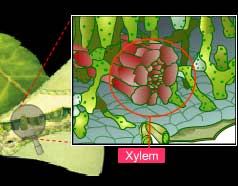
Transfer of water to a leaf through xylem
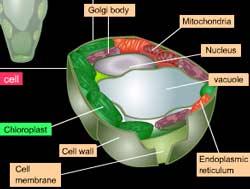
Parts of a plant cell
Transfer of water to a leaf through xylem
Parts of a plant cell
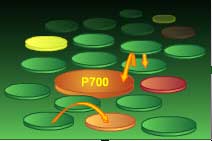
Energy transfer in photosystem I
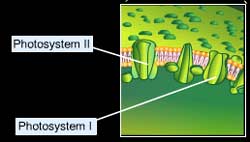
Photosystem I and II
Energy transfer in photosystem I
Photosystem I and II
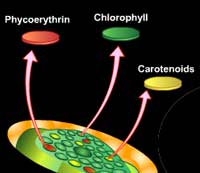
Location of pigments : Phycoerythrin, chlorophyll and carotenoids
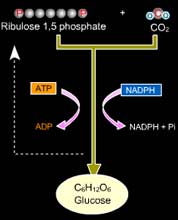
Calvin-benson cycle- simple format
Location of pigments : Phycoerythrin, chlorophyll and carotenoids
Calvin-benson cycle- simple format
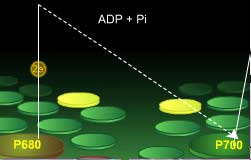
Electron transfer from Photosystem II (680) and Photosystem I (700)
Details of the animation/ movie /software

Photosynthesis: The process by which plants prepare their food

Photosynthesis is a process in which green plant prepare carbohydrate food (Glucose) with help of chlorophyll pigments by using carbon dioxide, water and sunlight

Equations: 6CO2+12H2O+ sunlight = C6H12O6 +6H2O +6O2

Raw material and Products of photosynthesis: The raw materials of photosynthesis are water and carbon dioxide, enter the cells of the leaf, and the products are sugar and oxygen. Water enters the root and is transported up to the leaves through specialized plant cells known as xylem

Carbon dioxide cannot pass through the protective waxy layer covering the leaf (cuticle), it enters the leaf through an opening (the stoma; plural = stomata)

Pigments: Chlorophyll pigments play important role in photosynthesis. They are situated in chloroplast of plant cell

Plants are green due to the photosynthetic pigment chlorophyll. Chlorophyll serves to reflect green and yellow wavelengths of light and absorb all the others.

Chlorophyll exists in two forms, chlorophyll a (the primary photosynthetic pigment) and chlorophyll b

Accessory Pigments: This is due to the presence of accessory pigments such as chlorophyll b, the Carotenoids, Phycoerythrin and Phycocyanin. Accessory pigments serve to capture light energy and transfer this energy to chlorophyll. Once absorbed the energy associated with the photon is used to begin the process of photosynthesis

These pigments are arranged in two types of unit photosystem I (P700) and photosystem II (P680).

Photosystems I and II (light dependent Reactions): Photosynthesis is a two-stage process. The first process is the Light Dependent Process (Light Reactions) and the other light independent one (dark reactions). The first one requires the direct energy of light to make energy carrier molecules that are used in the second process. The Light Independent Processes (or Dark Reactions) occur when the products of the Light Reaction are used to form glucose.

In the Light Dependent Processes, light strikes Photosystem I to excite electrons to a higher energy state. At the same time photolysis of water molecule take place and forms free oxygen, hydrogen and electrons. These electrons are transferred to Photosystem II to compensate its loss of electrons. Excited electron travel through electron transport chain, energy of flow of electron is use to convert ADP to ATP and then is passed to photosystem II. Again light energy excites it's electron and then it travel through ETS of photosystem II, at the end of chain NADP is converted into NADPH

Light independent process: In the Light Independent Process, carbon dioxide from the atmosphere is captured and combines with enzyme ribulose biphosphate form glucose using ATP and NADPH. A basic version of calvin cycle is shown.

Purchase to download and view unlimited times full-length animation or subscribe and view online all animation. More...

Product - Animation          Watch a free preview of this science  and technology animation
Description Preview Full Version Shop
Size (KB) 289 611 US$    15.00
Time (hr:min:sec) 0:2:15
Preview
0:25:0
Add To Cart
                                                                     Check price in your currency
Pay only $2 to watch full length animation online

Photosynthesis

Content : Science

Type : Animation

Duration : 25 minutes

The animation file contains the animation of the above mentioned detail section, it also includes the following

  • How light sustains life on earth ?
  • What is Photosynthesis ?
  • Structure of plant cell-mesophyll, inside chloroplast
  • Why do plants have green color ?
  • Photosynthesis pigments- Chlorophyll a and b,
    Carotenoids, Phycoerythrin & Phycocyanin.
  • Chemical reactions in photosynthesis:
    light dependent & light independent

Table of comparison between free-photosynthesis, photosynthesis and advanced photosynthesis versions

(Table of comparison between free-photosynthesis, photosynthesis and advanced photosynthesis versions)

go to photosynthesis free

go to photosynthesis advanced

Explanatory notes : no explanatory notes

Official PayPal Seal
Prices are for single user license, refer for School license here, You can also Subscribe to view full animation, More .. Note: (Some full version software does not contain sound),
Related Products
 
Buyers Feedback:

Q & A
Q1: what happen when there is no photosyntesis occur in a plant pejey 2/2/2010
Ans:
Q2: I PIMP THE SHIT OUT OF RICO LAMANYA AND CHRISTIAN THEY GET TBAGGED ALL DAY BY MY MAN SACK OF POWER AND MEAT POLE COVERED IN HAIR THROBBIN IN YOUR MOUTH AND ASSHOLE ROBERT SERNA 11/2/2009
Ans:
Q3: wich is responsible for the oxidation of the water,how water are give their electron to the pigment to come in their ground state vivek singh 4/7/2008
Ans:
Q4: when all phospahate are removed so what happens if possible Amir jamal khattak 16/1/2008
Ans: we get 3-phosphoglycerate (3PG)
Q5: how old are you? Bich Thuy 13/9/2007
Ans: We are eight years young, and like a eight year child most of us like watching cartoons, going to picnic, eating and playing games while working, working while eating, skipping office to loaf around and watch movies, love chocolates, sweets, cakes, pastries and holidays, hate milk and hate authority (not necessarily in that order).
Q6: WHY DO MOST PLANTS REFLECT GREEN WAVE LENGTH DDONNA CHARLES 5/7/2007
Ans: Chlorophyll-a strongly absorbs wavelengths around 430 nm (blues) and 662 nm (reds) out of the waveform of visible light to create food , chlorophyll – b also absorbs blue –greens and red-orange part of spectrum since greens and some yellows are not absorbed these are reflected back.
Q7: can you provide me some animations on xylem deepesh 19/3/2007
Ans: The animations are under development right now and will take some time - Admin
Q8: if any cancer related or cellular pocess related animation is there? punit 14/3/2007
Ans: We are coming up shortly with animation on cell membrane and another one on mitochondria, we have one on HIV but nothing till yet on cancer, let us know what you want on cancer we will take it up for research and production.
Q9: Êè§àǺä»ãËé ÁÔéÁ 18/1/2007
Ans: We are unable to understand your question ( can anybody else understand it ? ), please put it in plain English - Admin
Q10: where does the plant get energy to convert ADP toATP? jessica 12/1/2007
Ans: In plants, sunlight energy provides energy and in animals, the oxidation of glucose or glycolytic metabolism (obtaining energy from glucose), through Krebs cycle also known as the citric acid cycle provides energy for the conversion of ADP to ATP.
Q11: tell me about oxygenic and non-oxygenis photosynthetic prokaryotes bhavendra 3/11/2006
Ans: Within 5 groups of prokaryotes, Firmicutes, Chloroflexi, Chlorobi , Proteobacteria groups of bacteria have anoxygenic photosynthetic capability and have only one reaction center while oxygenic photosynthetic Cyanobacteria (also Blue Green Algae) have light harvesting pigments chlorophyll a and phycobiliproteins with PSI and PSII reaction center. Anoxygenic ones evolved much earlier than Cyanobacteria as initially prior to 2 billion years atmosphere was anoxygenic.
Q12: what is chloroplast? kairi 14/9/2006
Ans: These are disc or lens like organelles in plant cells and eukaryotic algae. They are green in color and capture light energy from the sun through a process called photosynthesis. They may be descendents of free-living cyanobacteria. These are responsible for the green color of leaves and plants and contains chlorophyll pigments, as well as yellow and orange carotenoid pigments.
Q13: how to found more animation about photosynthesis? ann 30/3/2006
Ans: Well you have to either purchase subscription or purchase product and download the animation of photosynthesis and advanced photosynthesis from our site to know more about it. We are not aware of other sources, maybe a search in yahoo or google will yield results.


Comments or Questions
  Give your feedback or ask a question.
Name *
Email *
Question *
Enter Code
Code Image - Please contact webmaster if you have problems seeing this image code Load New Code


Home | Products | Subscribe | Catalog | Register | Site Map | My Account | About Us | Contact Us | FAQ | Articles | Announcements | Downloads | Discounts | Advertise | Feedback
Copyright ©2007 Goalfinder.com All rights reserved. Copyright | License | Privacy policy | Contact us |