| Q1: |
Why didn't Millikan just hold various oil drops steady within the electric field to calculate the charge on the electron. Wouldn't he be able to neglect air resistance in this case? |
Siobhan |
25/2/2010 |
| Ans: |
|
| Q2: |
If the buoyancy of the air was neglected, how big of an error would have been introduced into the calculation of the charge? |
BOB |
21/2/2010 |
| Ans: |
|
| Q3: |
why milikan's introduce oil drops instead of electrons |
beenish |
10/2/2010 |
| Ans: |
|
| Q4: |
Describe Milikan's experiment due to an atom |
OLAWALE MATHEW |
8/2/2010 |
| Ans: |
|
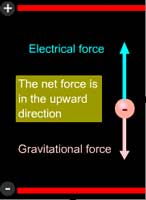
| Q5: |
what are the problems face by milikan during his oil drop experiment at that time? |
autansh |
4/12/2009 |
| Ans: |
|
| Q6: |
what is the applications of oil drop experiment? |
amrit |
1/12/2009 |
| Ans: |
|
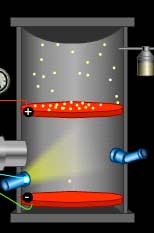
| Q7: |
application of milliken oil drop mehod |
mukesh |
11/10/2009 |
| Ans: |
|
| Q8: |
how was this experiment an impact towards atomic theory? |
C |
24/9/2009 |
| Ans: |
|
| Q9: |
how Milikan was able to achieve his aim for the experiments? |
kathlene |
15/2/2009 |
| Ans: |
|
| Q10: |
how Milikan was able to achieve his aim for the experiments? |
kathlene |
15/2/2009 |
| Ans: |
|
| Q11: |
WHY is this so bloody expensive, our school can't afford it :( |
David |
23/1/2009 |
| Ans: |
You can use the online viewing method, this will enable your school to view animation by paying subscription fee as low as $2 |
| Q12: |
how do i shot oil particle |
hurrdurr |
12/1/2009 |
| Ans: |
|
| Q13: |
Applications of Oil drop experiment |
Thilini |
14/11/2008 |
| Ans: |
|
| Q14: |
did the experiment support the theory of electron? |
patrick |
9/11/2008 |
| Ans: |
|
| Q15: |
what is the energy of free particle |
Soh Chai Yin |
8/8/2008 |
| Ans: |
|
| Q16: |
Define proper time, in accordance with the theory of relativity.(I am asking this Question 2nd time.) |
Naveed |
3/6/2008 |
| Ans: |
The time measured in the system in which the clock is at rest is called the "proper time". The time measured by an ideal clock that is carried along with a specified particle, and is based on the invariant timelike space-time intervals between points along the particle's trajectory. The time interval measured by an observer in his own reference frame. It is time measured by a single clock between events that occur at the same place as the clock. It depends not only on the events but also on the motion of the clock between the events. An accelerated clock will measure a shorter proper time between two events than a non-accelerated (inertial) clock between the same events. Proper time for an ordinary mechanical clock is recorded by the number of rotations of the hands of the clock. |
| Q17: |
Define proper time, in accordance with the theory of relativity. |
Naveed |
23/5/2008 |
| Ans: |
The time measured in the system in which the clock is at rest is called the "proper time". The time measured by an ideal clock that is carried along with a specified particle, and is based on the invariant timelike space-time intervals between points along the particle's trajectory. The time interval measured by an observer in his own reference frame. It is time measured by a single clock between events that occur at the same place as the clock. It depends not only on the events but also on the motion of the clock between the events. An accelerated clock will measure a shorter proper time between two events than a non-accelerated (inertial) clock between the same events. Proper time for an ordinary mechanical clock is recorded by the number of rotations of the hands of the clock. |
| Q18: |
Each time a new drop is injected, the radius can vary over a range of 20%. How much possible change can this cause the mass of the drop? |
Eddie |
11/5/2008 |
| Ans: |
|
| Q19: |
what is coupling & uncoupling states |
abeer |
28/3/2008 |
| Ans: |
Milikan balanced gravity against electric force, thus coupling between gravitational and electromagnetic fields is achieved by Milikan oil drop method, when the mass of “Millikan oil drops” is sufficiently large, then the coupling of the drops to gravitational fields can become large and when the charge of “Millikan oil drops” is sufficiently large, then the coupling of the drops to ectromagnetic fields can become large, also they should be sufficiently rigid and dissipationless (the two most important quantum properties for achieving a high conversion efficiency for gravity-wave antennas.) The drops can form a quantum transducer that converts gravity waves into electromagnetic waves. |
| Q20: |
what is the energy of free particle |
abeer |
28/3/2008 |
| Ans: |
|
| Q21: |
can not watch full version |
warunee |
17/3/2008 |
| Ans: |
Hi please send us a mail detailing what happened, we will be glad to provide you with assistance, generally you have to login and then click on full version button on the page to view the animation, that's it. Please do let us know |
| Q22: |
why millikan's used oil in his experiment instead of any other liquid. can we use any other liquid, if yes , then what should be the criteria. detailed answer... |
naveed |
4/3/2008 |
| Ans: |
Milikan had used oil as it has stable physical properties over a wide temperature span; it also has low viscosity, very high water repellency and low surface tension. A liquid fit for forming drops should not freeze nor evaporate during the experiment in other words it should have stable physical properties over a wide temperature span 40 °C up to 200°C, it should have low viscosity which means it should readily form drops, and low surface tension so that it does not stick to or smear any surface. It should free flowing and easily converted into droplets. Machine oil matched all of these criterions and so it was used. |
| Q23: |
how did this experiment affect the Atomic Model |
Blake |
28/2/2008 |
| Ans: |
The main aim of the experiment was to find the charge on an electron also it re-confirmed that electron was a sub-atomic particle. This did not however point towards any particular atomic model to be the correct one, since the experiment was not conducted with that aim. |
| Q24: |
what are there 4 forces acting on the oil drop |
thabiso |
23/2/2008 |
| Ans: |
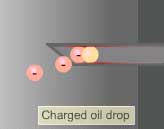
The four forces acting on the oil drop are 1) Drag force due to friction of air molecules calculated by stokes law, 2) Gravity – due to the oil drops weight 3) up thrust of air - the mass of air displaced by the oil drop 4) Effect of the electric field that exert a force on the drop. |
| Q25: |
what is solvent extraction?define in simple words. |
anum |
7/1/2008 |
| Ans: |
The separation of materials of different chemical types and solubilities by selective solvent action is called as solvent extraction. This technique depends upon the selective dissolving of one or more constituents of the solution into a suitable immiscible liquid solvent. It is used to refine petroleum products, chemicals, vegetable oils, and vitamins. One type is Liquid-liquid extraction, it is a method to separate compounds based on their relative solubilities in two different immiscible liquids. The basis of dry cleaning is the extraction of dirt and stains by applying a solvent—chlorinated hydrocarbon—that dissolves the stain but not the cloth. |
| Q26: |
why the oil particle do not recieve +ve charge? |
anum |
5/1/2008 |
| Ans: |
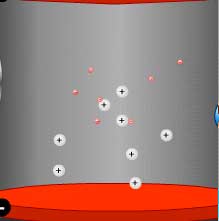
When the oil drops are sprayed through a nozzle and collide with air they are mainly negatively charged as air molecules take away the electrons but in the chamber the oil drops frequently collide with the positively charged air molecules to get a positive charge. Hence not all oil drops were negatively charged, infact positively charged oil drops formed an important part of the experiment. |
| Q27: |
what are the positive rays? |
c.b.kangulkar |
28/8/2007 |
| Ans: |
Positive rays or canal rays are observed as pencil of rays when streaming through the holes of perforated cathode in a gas discharge tube in a direction opposite or cathode rays, these were observed by Eugen Goldstein, in 1886 and 16 years later confirmed by Wien as carrying positively charged particles equal in mass to the hydrogen atom. Wien’s particle was later named as proton. |
| Q28: |
10. In what ways is this simulation a simplification of Millikan’s original experiment? |
sammy |
14/6/2007 |
| Ans: |
This animation explains the concept in a visual manner, it explains Millikan oil drop experiment in a systematic and logical order and we have made efforts to elaborate wherever confusion might exist with tool tips and explanatory animation. Detailed derivations, zoom-in views, explanation supported by animation makes this “simple” and “easy” to understand. We have given an in-depth treatment & through animation made it simple to understand, but have not simplified the experiment in any manner. |
| Q29: |
what is significance of E=mc*c |
sandeep |
19/5/2007 |
| Ans: |
Mass Energy equivalence: In a closed system, the total amount of mass and energy in a remains constant this implies energy can neither be created or destroyed, and in all of its forms, trapped energy exhibits mass. As per relativity mass-energy are inseparable and existence of one without another is infeasible. |
| Q30: |
what is physics behind franck hertz experiment? |
sajjad akhtar |
11/5/2007 |
| Ans: |
The experiment confirmed that electron wont jump to excited state until energy crosses a particular threshold. Reasoned on elastic and inelastic collisions of electrons with the mercury atoms. Prior to 4.9-volt threshold the collisions are elastic (no energy loss) and current rises but it drops at 4.9 (electrons lost their energy to mercury atom, an inelastic collision), KE of electron converts to PE of Hg that emits UV spectral line. Current rises and falls with 4.9 volt increments (threshold) |
| Q31: |
Why do electric field not affect some of the drops? Why do some of the drops require negative rather than a positive balancing voltage |
Richmond |
1/5/2007 |
| Ans: |
Some of the oil drops that fell through the orifice were either not charged or lost their charge in collisions; secondly, gravity and drag force played a role in nullifying the effect of field. A higher negative potential was used to make it move upwards to calculate the value of charge, as keeping the drop stationary was practically very difficult. |
| Q32: |
why ac supply provided in balmer series experiment? |
sajjad akhtar |
12/4/2007 |
| Ans: |
Balmer series experiment uses photomultipliers or light detectors with high detection area and internal amplification. These are made from glass vacuum tube, and typically require 1000 to 2000 volts for proper operation. This amplication is provided by a HV unit. The input power is taken directly from the ac line. The output voltage can be controlled from ±10 to 3000 V. High-Voltage Power provide the noise-free, well-regulated, very stable high voltage necessary for proper operation of devices. |
| Q33: |
Which view we are applying electronic or conventional view in case of direction of feild between plates? |
Aamir Razaq |
9/4/2007 |
| Ans: |
we are applying the conventional view |
| Q34: |
what s the composition of silicon oil |
easyreagent |
14/3/2007 |
| Ans: |
You can use Dow Corning 200 fluid (or DC 200) Silicone Oil – Polydimethlysiloxane, it has stable physical properties over a wide temperature span 40 °C up to 200°C, it also has low viscosity, very high water repellency, low surface tension. |
| Q35: |
why a green circle appear in charge mass ratio experiment even electron can not be seen |
ikram ullah |
20/2/2007 |
| Ans: |
Electrons strike the fluorescent screen containing phosphor to produce a glow. A phosphor is a substance that exhibits the phenomenon of phosphorescence. For CRT a combination of zinc sulfide with copper or zinc sulfide with silver when excited by electrons, provides strong green or blue glow. So the electrons need not be seen but their presence can be indicated by glow. |
| Q36: |
which kind of charge on both plates of capcitors in Millkan oil drop experiment? |
waseem siddiqui |
7/2/2007 |
| Ans: |
Upper plate positive, bottom plate negative charge. The upper plate also had a hole in it for the droplets to pass through. |
| Q37: |
stoke's law |
Ghulam rasool |
7/2/2007 |
| Ans: |
Please refer to the questions below |
| Q38: |
procedure for millikan's oil drop method |
imran ashraf |
7/2/2007 |
| Ans: |
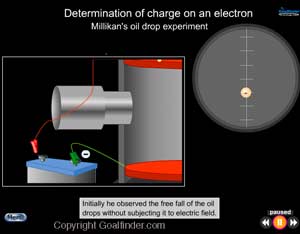
Set up the apparatus with an airtight chamber and atomizer. Introduce oil droplets in the chamber. Observe the velocity of drops through microscope, calculate terminal velocity establish electric field, note velocity again. Make the drop stationary by changing electric field. Calculate charge on the drop for various voltages. Establish charge is an integral multiple of the smallest integer. Better refer a book for detailed instructions about procedure or why not see our animation ;) |
| Q39: |
why we use silicon oil in Millikan oil drop method experiment? |
waseem siddiqui |
7/2/2007 |
| Ans: |
Silicon oil was used as it is non-volatile but actually it is not good enough mineral oil (Locke watch oil) is better. |
| Q40: |
What is stoks law ?What are its limitations ?Please widly explain |
Nouman bashir |
1/2/2007 |
| Ans: |
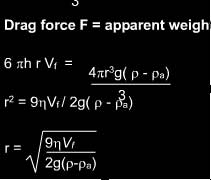
Stoke’s law describes the constant settling velocity of a smooth, rigid sphere in a fluid of known density and viscosity n. It is given by V = (2gr²)(d1-d2)/9n, here r = A radius, lesser than actual radius for a non-spherical particle. Here the frictional drag force (F=6(pi) r n V,) equals the gravitational one. The accuracy for V and F fall for an irregular droplet, as r cannot be determined correctly, also the flow should be laminar or streamline (no exchange of momentum between particles). |
| Q41: |
what is terminal velocity?How stoks law involvesin millican experient?what are the limitations of stoks law? |
Nouman Bashir |
1/2/2007 |
| Ans: |
A falling droplet experiences both drag and gravitational force, when the effect of both nullifies each other, the droplet experiences no net force and falls with uniform velocity called terminal velocity. The drag force here is calculated using stokes law. Stoke’s law drag calculation is inaccurate for irregular shaped particles as their diameter cannot be determined accurately and they rotate and move in a spiral due to moment while falling as force does not act on its center of gravity. |
| Q42: |
what is physics |
s |
1/2/2007 |
| Ans: |
Physics as per wikipedia is the science concerned with the discovery and understanding of the fundamental laws which govern matter, energy, space, and time (Frankly these you could have conserved by researching this question on 126 million links for physics in Google). |
| Q43: |
how the electron was able to move around the nucleus continuously with out loosing any energy? |
suryateja |
11/1/2007 |
| Ans: |
Bohr did a lot of work in this area and proposed quantum energy states where the electron did not lose any energy while rotating this can be understood by models of gravity well (or potential well) exhibited in museums where, in absence of friction, metal balls can rotate at different depths without losing orbit for quite some time. We are shortly releasing an animation on Bohr model and hope that it will explain the concept more clearly. |
| Q44: |
how the oildrops become charged? |
jalpa soni |
1/12/2006 |
| Ans: |
Due to electrostatic effect – when oil drops comes in contact with nozzle or dry air, due to adhesion, forms a chemical bond with them, here they take electrons from them and become negatively charged when they are separated. This charge imbalance causes air to become positively charged. This is the same process by which a comb acquires charge when rubbed on dry hair or in winter when your woolen clothing charge your hand and a spark occurs when you touch a doorknob. |
| Q45: |
can you tell me how to make a simple writer abaut oil`s drop experiment |
taufik |
17/11/2006 |
| Ans: |
Simplicity is tougher than complexity; we know how difficult it is to present science concept in a simple way. Start with wikipedia.org they have wrapped it up in a 1.5 page, other way is to remove all ‘whys’ and just focus on ‘hows’ in your article, whys cause maximum troubles, just report on what happened and leave out the background. It will be simple but I guess you need to provide some explanations which in turn may require details. As a better article provides concise but handy info. |
| Q46: |
how did thomson and others defined what is electricity before the discovery of electrons |
K.S.N.SUHAS |
20/9/2006 |
| Ans: |
Good question. Centuries before Thomson’s electron came, electricity was defined as flow of charges both positive and negative by Benjamin Franklin in 1727. Word “electron” was coined by Greeks in 600 BC. Volta, Edison, Ohm, Henry and other scientist were comfortable with the concept of charges. In fact electricity is incorrectly thought to be a flow of electrons even today, it is a flow of ions in batteries, electrons in metals, while two way flows in the sky, our body, air cleaners etc. |
| Q47: |
How can I create positive or negative charge to a solid surface in a low cost ? |
R.Kannan |
1/8/2006 |
| Ans: |
Low cost is a constraining factor, for any solid surface a charge can be induced or introduced by either rubbing it or inducing it with another object .For example, when a glass rod is rubbed with silk, electrons will move from glass to silk leaving the glass rod positively charged while the silk wrap negatively charged, electrostatic induction can also be used by bringing a charged rod near the object. Does this answer your question? |
| Q48: |
How can I create positive or negative charge to a falliing liquid drop in a low cost ? |
R.Kannan |
1/8/2006 |
| Ans: |
We are quite lost out on the low cost part, a charge on the drop can be created by ionising air through which the drop falls, this can be done by electrodes (costly) or by laser of around 100 W (not cheap), or by ioniser releasing ions (again not cheap). |
| Q49: |
how can we find terminal velocity? |
M Khizar Abbas |
24/6/2006 |
| Ans: |
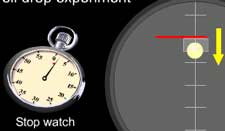
Without applying an electric field note down the time and measure the distance between any two gradations in the eyepiece of the microscope |